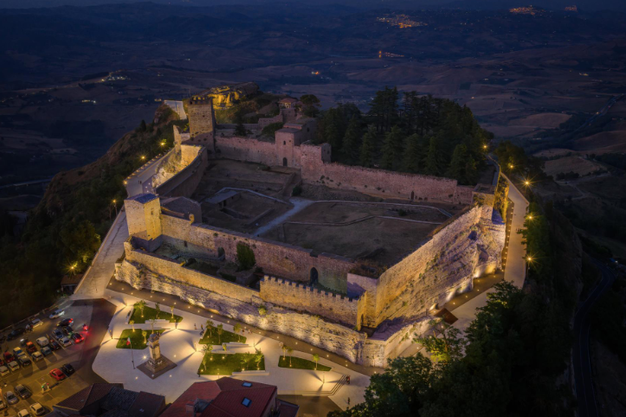
Enna's Castello di Lombardia, one of Italy's largest and best-preserved medieval fortresses, has undergone a significant urban regeneration project, with lighting design playing a central role. Promoted by the Municipality of Enna and supported by PNRR (National Recovery and Resilience Plan) funding, the initiative was led by architect Andrea Caporali with architect Adriano Furma and landscape designer Roberta Andaloro of Studio Omphalos.
 © Platek
The project encompassed the entire area surrounding the fortress, including Viale Nino Savarese, Piazza delle Rimembranze, Rocca di Cerere and adjacent pedestrian paths. Its aim was to integrate contemporary functionality with respect for the historical and archaeological context.
Lighting manufacturer Platek was chosen as a key partner, supplying a wide range of outdoor solutions, many customised in-house by its R&D department. The guiding principles were visual discretion, structural durability and optical precision.
Among the highlights is the debut of TIKAL, a compact step light designed by Platek's R&D team. Fixed directly to the corten steel balustrade of the stairway linking Viale Nino Savarese with the Museo del Mito, it provides uniform, well-directed light without visual clutter. Architect Andrea Caporali commented: "With Tikal we were able to achieve a lighting effect that is focused yet discreet, fully consistent with the architectural language of the project. It is a light that is ever present, but never imposing."
Other bespoke interventions include SUN pole-mounted projectors (by Lundbergdesign) to illuminate castle walls and entryways, MEDIO recessed fittings to highlight the rocky escarpment, MINI recessed products to enhance the War Memorial and trees in Piazza delle Rimembranze, and TRIS poles to provide soft, diffuse light for social spaces. Along pedestrian paths, SPY step lights were integrated into existing walls to guide visitors with a gentle glow.
The collaboration between Platek and the design team was built on dialogue, from optics selection to customised finishes. This partnership ensured that lighting not only enhanced safety and usability, but also enriched the architectural and cultural narrative of the site.
The Castello di Lombardia project demonstrates how lighting can support sustainable urban regeneration, amplifying heritage while preserving its identity. For Platek, the development of TIKAL represents a new tool for designers seeking compact, efficient and discreet solutions for contemporary architectural and public lighting.
More information:
Platek
[email protected]
www.platek.eu